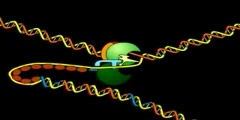
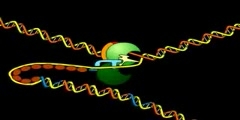
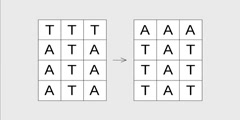
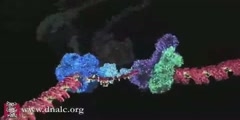
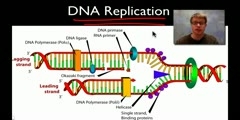
Description (Edit): DNA replication or DNA synthesis is the process of copying a double-stranded DNA molecule. This process is important in all known life forms and the general mechanisms of DNA replication are not the same in prokaryotic and eukaryotic organisms. As each DNA strand holds the same genetic information, both strands can serve as templates for the reproduction of the opposite strand. The template strand is preserved in its entirety and the new strand is assembled from nucleotides. This process is called semiconservative replication. The resulting double-stranded DNA molecules are identical; proofreading and error-checking mechanisms exist to ensure near perfect fidelity.
In a cell, DNA replication must happen before cell division. Prokaryotes replicate their DNA throughout the interval between cell divisions. In eukaryotes, timings are highly regulated and this occurs during the S phase of the cell cycle, preceding mitosis or meiosis I. DNA replication may also be performed in the laboratory in a process known as PCR.
less...
Description (Edit): DNA replication or DNA synthesis is the process of copying a double-stranded DNA molecule. This process is important in all known life forms and the general mechanisms of DNA replication are not the same in prokaryotic and eukaryotic organisms. As each DNA strand holds the same genetic information, both strands can serve as templates for the reproduction of the opposite strand. The template strand is preserved in its entirety and the new strand is assembled from nucleotides. This process is called semiconservative replication. The resulting double-stranded DNA molecules are identical; proofreading and error-checking mechanisms exist to ensure near perfect fidelity.
In a cell, DNA replication must happen before cell division. Prokaryotes replicate their DNA throughout the interval betwee...
more....